
The short, loud life of the #36 Cavalier
Every race car has a story. Some of them run for years, racking up trophies and hard-earned scars on the quarter-panels. Others burn bright and burn fast, leaving behind a few good laps, a couple of great photos, and a memory that everyone at the track will be telling stories about for a long time.
This is the story of the second kind.
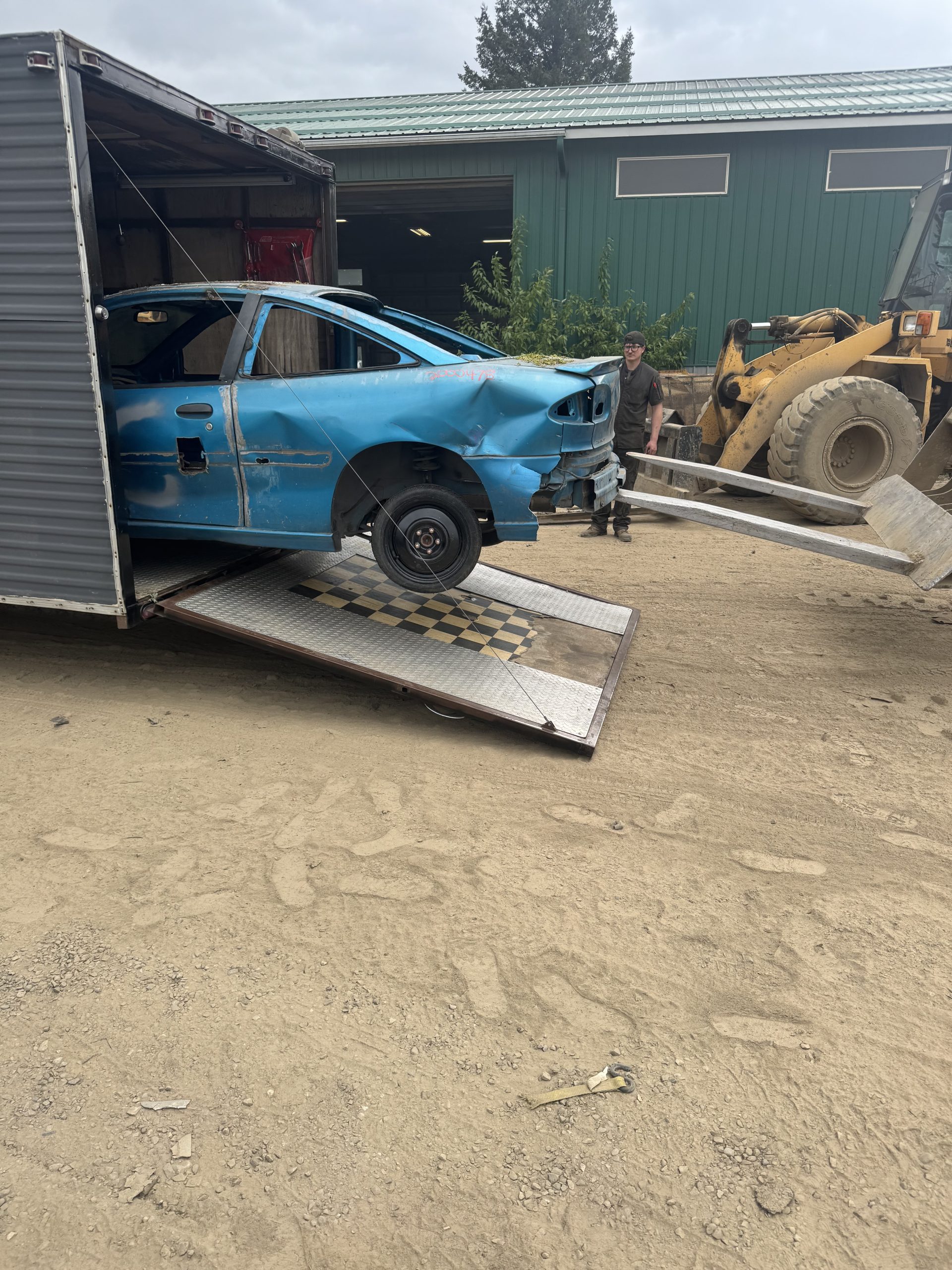
The plan
The plan was a good one. Carter, part of the Williams Racing team, was supposed to climb into a 1997 Chevy Cavalier and run his first real season in the Roadrunner class at Stateline Speedway in Post Falls, Idaho. For anyone who hasn’t been out there, Stateline is one of those classic Pacific Northwest short tracks — a 1/4-mile paved oval tucked into the rolling fields and pine country just over the Idaho line, where on a clear evening you can watch the sunset light up the mountains while engines warm up in the pits.
The Roadrunner class is exactly where a new driver wants to start. Affordable cars, four-cylinder front-wheel-drive economy boxes, and a field full of drivers who are usually more interested in close, clean racing than tearing each other apart. It’s the proving ground. It’s where you learn the line, learn the car, and figure out whether you actually want to do this every weekend for the rest of your life.
To get there, Carter went to work with Jamie Allen of Allen Racing. If you spend any time around the dirt and asphalt tracks of the Inland Northwest, you know Jamie’s work. The two of them put in the hours — gutting the Cavalier, caging it, prepping the suspension, painting it up, slapping the #36 on the doors. Photos of the finished car show that blue paint job catching the speedway lights, ready to go to work.
It looked the part. It sounded the part. It was supposed to be Carter’s first race car.
Five days
Then came final testing.
Anyone who’s ever built a car knows the feeling. You’ve done the work, you’ve checked everything twice, you button it all up, and then you fire it up for the shakedown run. That’s when the car gets to tell you what it really thinks of your plan.
That’s the kind of news that lands hard. A cracked block isn’t a “swap a part and keep going” kind of problem — not on a budget, not on a five-day timeline, not when you’ve already poured weeks of nights and weekends into the build. The Roadrunner debut was off. The car that was supposed to carry a rookie through his first laps under the lights was, mechanically speaking, done.
A lot of cars would have gone straight to the scrapper at that point. But this one still had a little fight left in it.
The roller derby
For folks unfamiliar, a roller derby at a place like Stateline is a cousin of the classic demolition derby — except instead of milling around in a dirt pit, everyone runs the actual track, in the same direction, and the last car still moving wins. It’s chaos with a racing line. Cars hit, cars spin, cars stall out, cars get launched. The crowd loves it because it’s the kind of motorsport that doesn’t pretend to be anything other than what it is: loud, dangerous, and a whole lot of fun.
A cracked block doesn’t matter much when the goal isn’t to finish a 50-lap feature. It just needs to run long enough to put on a show. So that’s where the #36 went.
Carter strapped in. The car fired up. And for one more night, the Cavalier was a race car.
It knocked down a few laps. It traded paint. It did exactly what it was built to do, just not in the class anyone had planned for. And then — because if you’re going to send a car off, you might as well send it off properly — Carter pointed the nose at the jump in the middle of the track and got the Cavalier airborne.
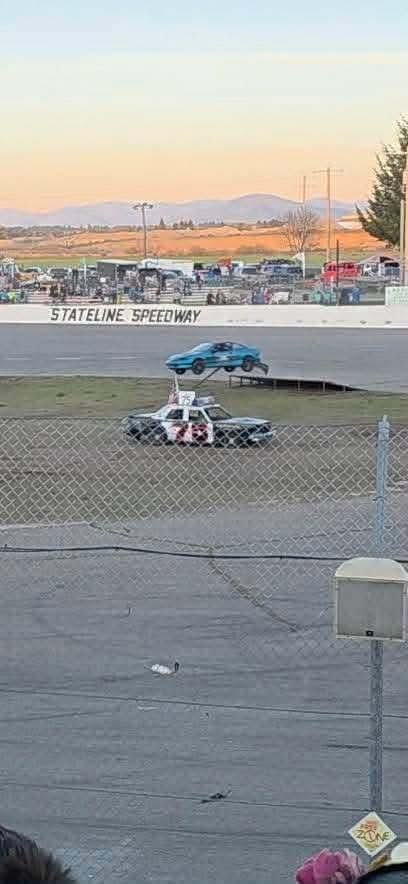
That photo, the one with the blue Cavalier suspended over the infield with the sunset behind the mountains? That’s the moment. That’s the whole story in one frame. A car that was never supposed to fly, doing exactly that, in front of a Friday-night crowd at a little speedway in north Idaho.
The scrapper
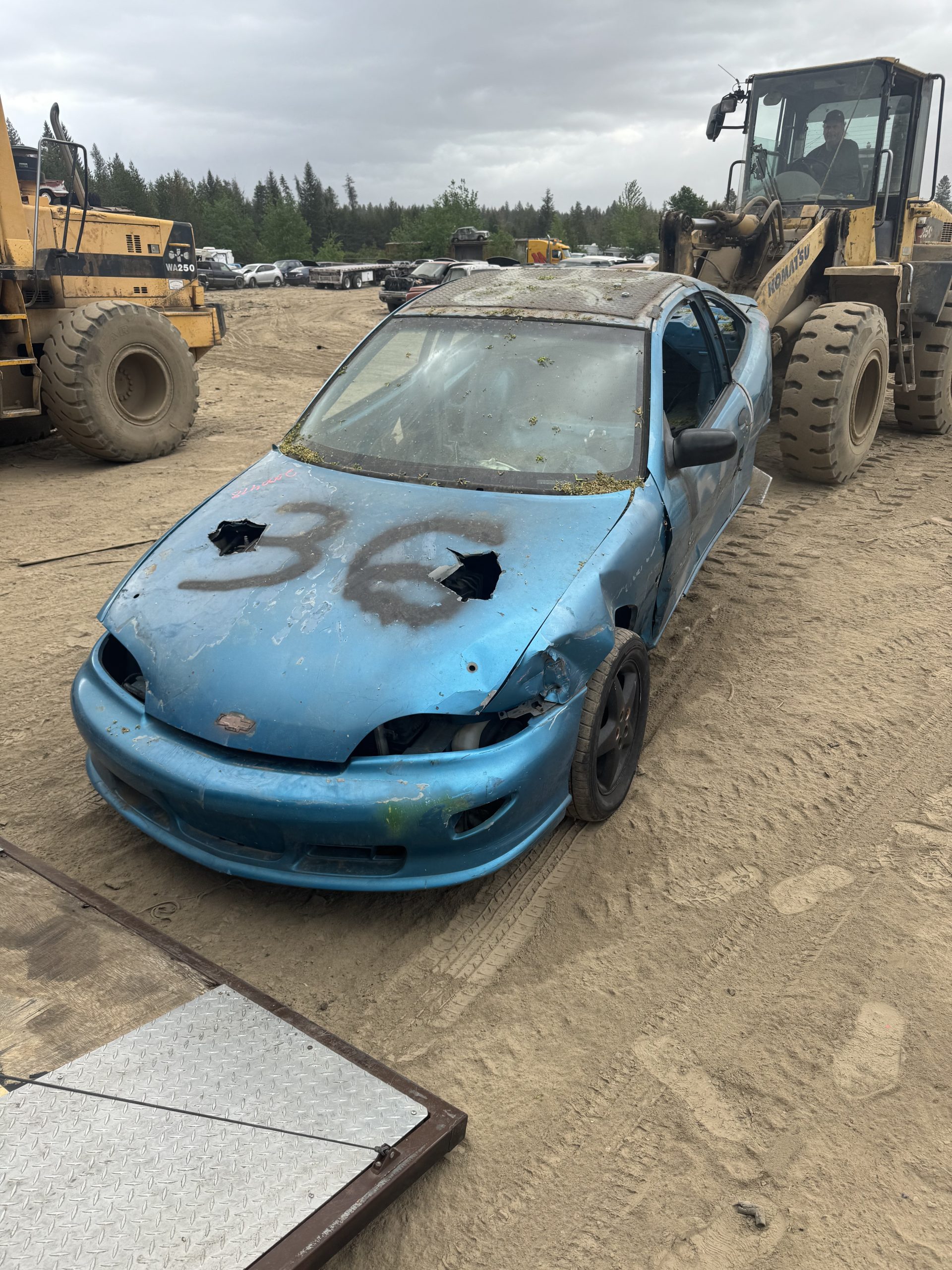
After the roller derby, the #36 made one last trip — to the scrap yard. The block was done. The body had given everything it had. There was nothing left to salvage that was worth the cost of saving it.
It’s easy to look at that ending and call it a loss. A car built for one class, never raced in it, finished off in a demo event and hauled away for scrap. On paper, that’s not the dream debut anyone had in mind.
But here’s the thing. Carter learned how to build a race car. He spent real time in the shop with Jamie Allen, which is its own kind of education that you can’t get any other way. He got behind the wheel under the lights at Stateline. He raced. He survived contact, kept his head, and finished the night by sending a car into orbit in front of a grandstand full of people who will remember it.
For a first race car, that’s not a bad résumé. The Cavalier didn’t get to be what it was supposed to be. It got to be something better — a story.
What’s next
The #36 is gone. But Carter is still here, Williams Racing is still here, and Allen Racing is still here. There will be another car. There will be another first race. And whoever’s in the field the night Carter rolls out for his real Roadrunner debut should know — this is a driver who’s already learned one of the most important lessons in racing.
See you at Stateline.
Follow the team
The next Williams Racing build is already in the works. For updates on Carter’s return to Stateline and the rest of the 2026 schedule, check the schedule on the homepage or follow Williams Racing on social.